The multi-stakeholder convening of the Official Pre-Summit Event of the AI Impact Summit 2026 held on January 27, 2026, on the theme “Advancing Child Safety in the Age of Artificial Intelligence”, underscored a shared recognition that artificial intelligence is no longer a future concern for children, it is already shaping how they learn, socialize, seek support, and experience harm. Across government, law enforcement, legal, research, industry, and civil society voices, there was strong agreement that child safety in AI-enabled environments must be treated as a priority issue, not a secondary or reactive one.
Indian Government speakers emphasized that protecting children online is a moral and constitutional responsibility. While AI presents clear opportunities, particularly in education, access, and early identification of risk, participants stressed that unchecked systems can also build dependency, manipulate behaviour, and scale harm rapidly. Transparency, safety-by-design, and accountability emerged as core principles, with clear support for measures such as mandatory labelling and watermarking of AI-generated content, algorithmic accountability, and safeguards that prioritize child well-being over engagement metrics.
Evidence shared by Childlight highlighted the alarming scale of technology-facilitated child sexual exploitation and abuse. Data pointed to sharp increases in AI-generated abuse material, sexual extortion, and online solicitation, alongside strong links to long-term mental health impacts. A key message was that AI-generated abuse constitutes real abuse, with enduring harm, and must be treated with the same seriousness as offline offences.
Law enforcement perspectives reinforced that regulation must be matched by capacity on the ground. AI is already being used to filter, prioritize, and act on large volumes of CSAM reports, demonstrating that technology can be part of the solution if deployed responsibly. At the same time, speakers noted the need for continuous legal evolution, clearer liability frameworks, and responsibility across both large and smaller platforms, including gaming environments.
The draft roadmap presented by the Expert Engagement Group reflected broad consensus on moving beyond blunt access controls. Instead, participants called for enforceable safety standards, techno-legal approaches, and hyper-localised solutions that recognize India’s diverse realities. Youth voices added urgency, reminding stakeholders that harms often enter children’s lives quietly and that their lived experiences must inform design, policy, and governance.
Together, the discussions produced a clear outcome: advancing AI innovation while embedding child safety by design, through collaboration, evidence, and workable regulation, as India prepares for the AI Impact Summit 2026.
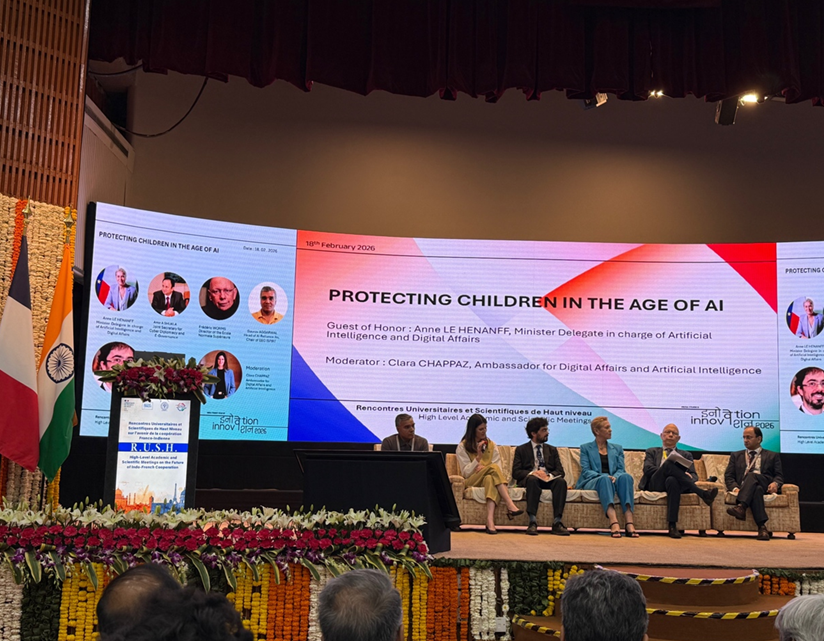
Some weeks later, during the round table “Child protection & AI” organized by the French Embassy on the future of Franco-Indian cooperation on February 18, 2026, during the High-Level University and Scientific Meetings (RUSH) — in the presence of, among others, Minister Anne Le Hénanff, Ambassador Clara Chappaz, and iSPIRT, The French minister declared: “It’s clear that in the system today, something is rotten. When you look at the situation of our children or teenagers, when you think about social media and if you add to it some AI chatbot, this is the beginning of a terrible situation,” said Emmanuel Macron on Wednesday, February 18, at an event held alongside the Global Artificial Intelligence Summit, which took place from February 16 to February 20 in New Delhi. The French president was supporting remarks made earlier during a conference organized by Anne Le Hénanff, the minister delegate for AI and digital affairs. Its aim was to promote the theme of child protection, with a particular focus on chatbots such as ChatGPT, Gemini, Meta AI, Grok and others.
“The massive adoption of AI, at an unprecedented speed, brings new dangers. We must protect our children in their digital lives,” the minister explained, drawing a direct parallel with the bill banning social media for minors under 15, passed in January by the National Assembly. “We will use the same approach: relying on a scientific consensus,” she described.
Results:
- A final report “Expert Engagement Group on Child Safety” have been signed;
- An international partnership involving iSPIRT has been settled.